Design Services
Beyond FPGA: The Full Spectrum of Electronics Design Services
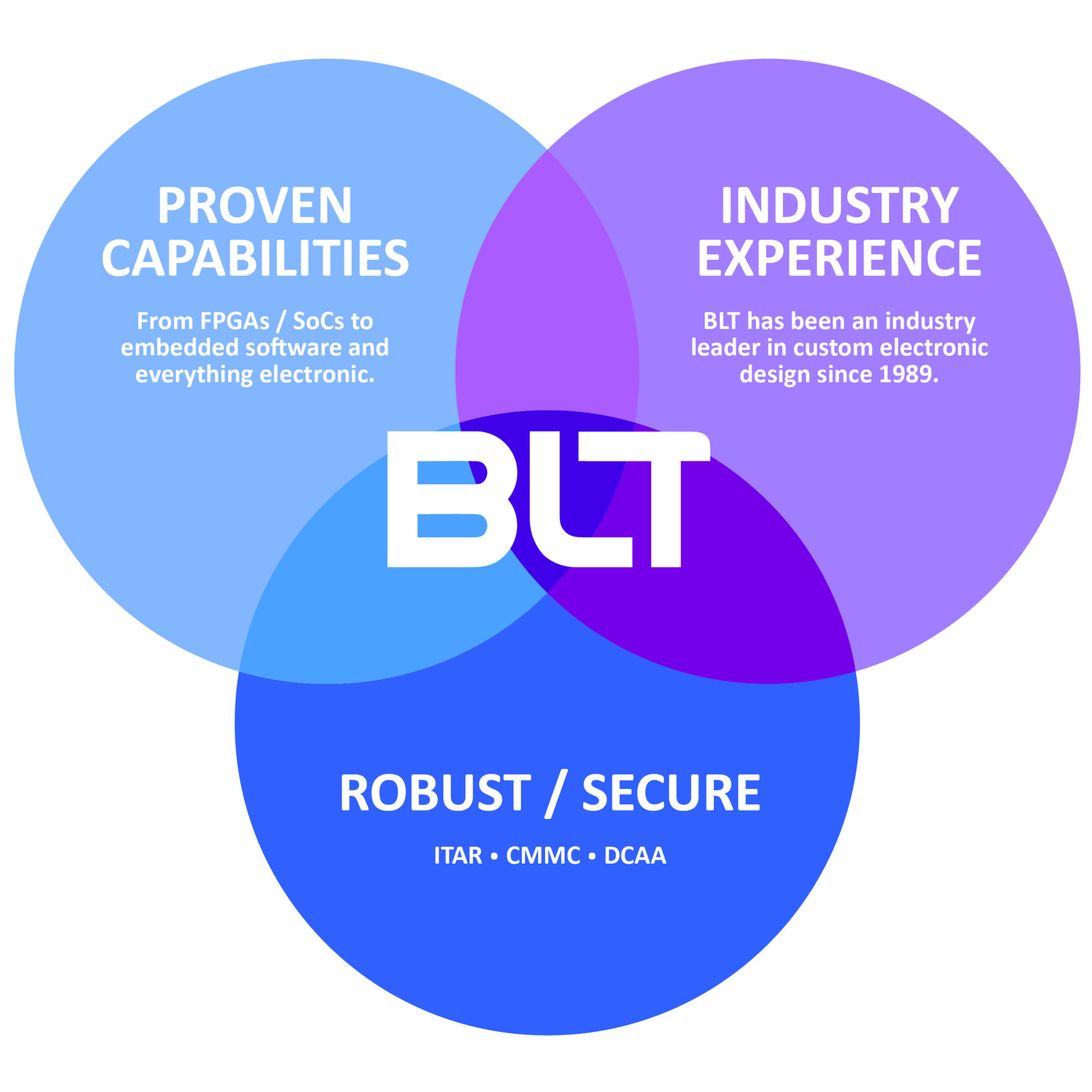
At BLT, we’re more than FPGA experts. We offer a full range of custom electronic design services and solutions, and partner with you to solve even the most complex design challenges. Since 1989, we’ve helped clients accelerate time to market with reliable, high-quality electronic systems—done right the first time, every time, and always on budget.
When it comes to electronics design, we set the standard. Even our competitors come to us to learn from our success. From architecture to implementation, our team tackles technical challenges others won’t touch. Whether you’re up against tight timelines, in need of specialized expertise, or looking to augment your engineering team, BLT scales to meet your needs without compromising quality. In fact, we guarantee our work on fixed price contracts.
You’ve got innovation to deliver. We’ve got the experience to make it real.

ENGAGE
Let’s start with a conversation. You tell us your vision, challenges and goals for your project or product.
ASSESS
Our experts evaluate your requirements, identify key technical needs and define the path forward.
DESIGN
We architect a custom solution tailored to your project, including your budget, schedule, and criteria.
TEST
We rigorously verify functionality, performance, and compliance, ensuring your design is robust and reliable.
DELIVER
From prototypes to production-ready systems, we deliver results that meet your specs, schedule, and expectations.
Our Design Services
Our Clients




















Government & Commercial Design Services
Besides our robust commercial design services, BLT also provides engineering design services and solutions tailored to the unique needs of the US government and defense primes. With expertise across a broad range of technologies, we specialize in mission-critical environments. We can solve your most complex engineering challenges.
- VOSB (Veteran-owned small business)
- CMMC Compliant
- ITAR Registered
- SAM ID: contact us
- DUNS: contact us
- CAGE Code: contact us
- NAICS Codes: contact us
We don’t just design electronics. We design success.
BLT can solve your toughest design challenges so you can bring your product to market with confidence. Your success is our success. Ask our engineering experts how we can help you.
What We Do
- AMD devices and tools
- Altera devices and tools
- Microchip devices and tools
- Lattice devices and tools
- HDL design
- High-speed digital design
- PCB layout & design
- Communications systems
- Software-defined radio
- Satellite / Space
- Rapid prototyping
- Turn-key system development
- DSP design (C, HLS, Matlab)
- Design for SWAP-C
- AI / ML
- FPGAs, SoCs, and SoMs
- Front-end ASICs
- Signal and Power Integrity
- RF Design
- Reconfigurable computing
- Vision systems
- Cross-domain solutions
- Anti-Tamper and SSE
- Signal Processing
- Partial Reconfiguration (DFX)
- Isolated Design Flow (SCC)
- System Architecture
- Debugging
- Embedded Software
- Embedded processing
- Supercomputing
- Hi rel/rad hard applications
- Test and measurement
Industries We Serve
We serve commercial, aerospace and defense, space, medical, industrial, government and intelligence clients whose electronics design services needs push technology to its limits. Whether you’re facing a complex design challenge, need to get to market faster, or want to push the limits of programmable chip technology, we have the knowledge and expertise to help.